
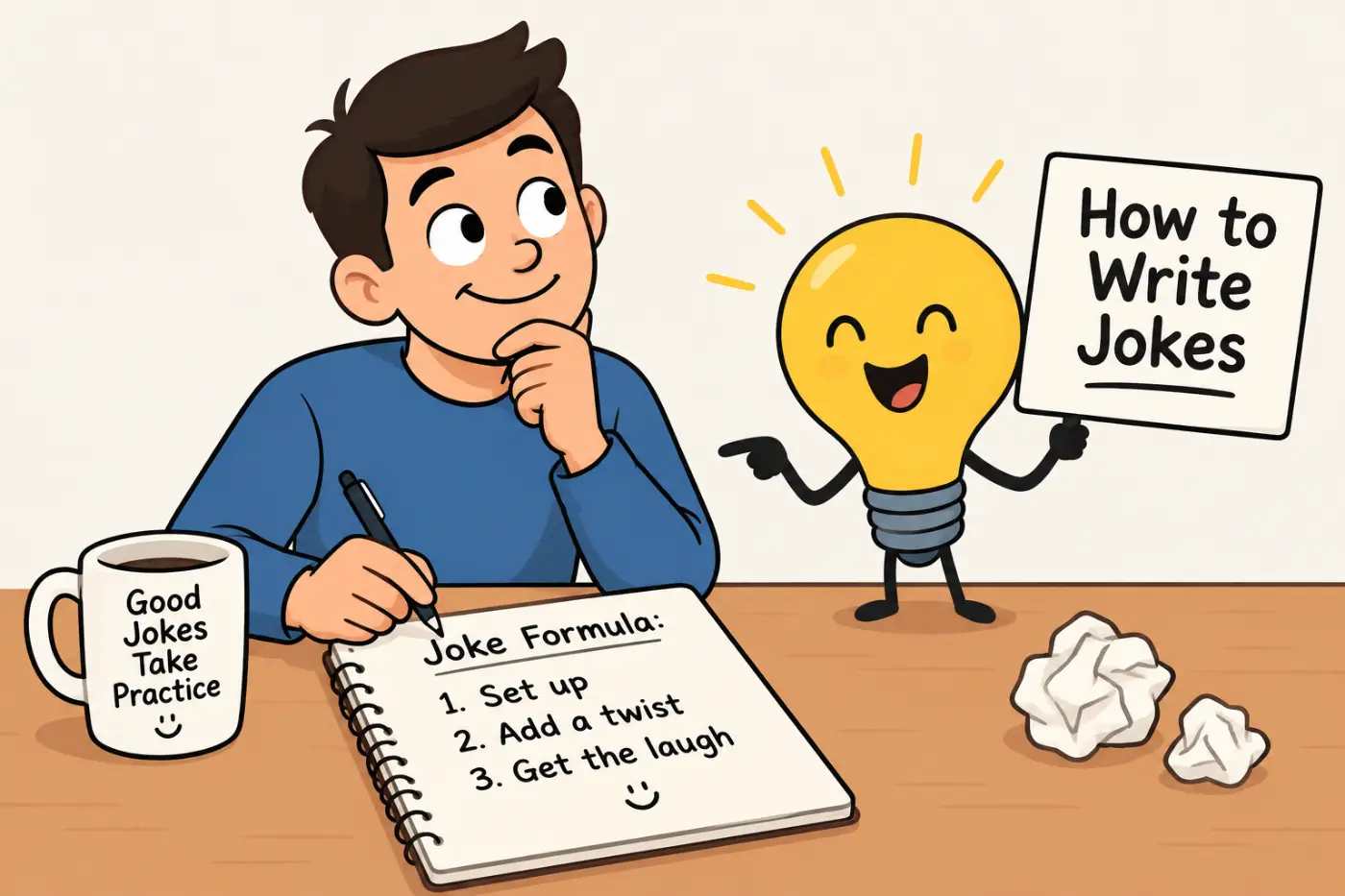
How to write jokes is a question every aspiring comedian, humor writer, and pun lover eventually asks. The good news? You don’t need a comedy stage, a microphone, or a notebook full of perfect punchlines to get started. You need curiosity, a little creativity, and the willingness to look at ordinary life from a funny angle.
Think about it: everyday situations are packed with comic material. Your alarm clock betrays you, your coffee disappears before your first meeting, and your shopping list somehow costs more than your dinner plans. These little frustrations can become memorable one-liners when you add surprise, exaggeration, or clever wordplay.
This guide combines practical joke-writing techniques with ready-to-use examples, from puns and observational humor to funny questions and unexpected endings. Whether you’re writing social media captions, entertaining friends, or developing a comedy routine, you’ll find ways to practice and improve your punchlines.
How to Write Jokes Using Everyday Observations
One of the easiest ways to learn joke writing is to notice the small things people recognize immediately. Everyday annoyances, awkward moments, and familiar habits provide excellent material because the audience already understands the situation.
- My alarm clock and I have a toxic relationship. It screams, and I hit snooze.
- My coffee doesn’t solve my problems, but it helps me tolerate their meeting invitations.
- I cleaned my room by moving everything into a different pile.
- My shopping list said five items. My receipt told a longer story.
- I started jogging yesterday. Unfortunately, I was running late.
- My phone battery drops faster than my motivation on Monday.
- I opened the fridge for inspiration. It offered cheese and disappointment.
- My laundry basket has developed its own property market.
- I bought a planner to organize my life. Now I have scheduled chaos.
- My diet starts tomorrow because today has already made several commitments.
- I asked my houseplant for advice. It told me to branch out.
- My vacuum cleaner has one job, yet it keeps sucking at it.
- I tried to save money by staying home. Then I ordered dinner.
- My inbox is a museum dedicated to things I should have answered.
- I took a day off to relax and spent it worrying about relaxing.
- My bed is a persuasive speaker with excellent closing arguments.
- I organized my desk, and now I can’t find anything.
- My GPS says, “Turn around,” which is also my career advice.
- I made a to-do list so long it needs its own assistant.
- My house is clean enough to be healthy and messy enough to be interesting.
- I bought noise-canceling headphones to ignore my own thoughts in premium silence.
- My favorite exercise is running out of patience.
- I tried waking up early, but my pillow filed an appeal.
- I don’t procrastinate. I give my deadlines time to mature.
Pro Tip: Keep a daily notes file with five things that annoyed, surprised, or amused you. Turn one observation into three different punchlines, then keep the version with the clearest surprise.
How to Write Jokes With a Setup and Punchline
A classic joke often has two parts: the setup creates an expectation, and the punchline changes it. The audience follows one path, then discovers an unexpected ending. That small shift is where the laugh often happens.
Try these examples to see how a simple setup can lead somewhere surprising.
- I told my boss I needed a raise because three companies were after me. He asked which ones. I said, “The electric company, the internet company, and the water company.”
- I asked the librarian for a book on paranoia. She whispered, “It’s right behind you.”
- I started a business selling invisible ink. The launch was a complete blank.
- My friend said he was great at multitasking. He can waste time, be unproductive, and procrastinate all at once.
- I told my suitcase there would be no vacation this year. Now I’m dealing with emotional baggage.
- I wanted to write a joke about construction. I’m still working on it.
- My doctor told me to watch what I eat. Now I eat in front of a mirror.
- I asked a baker how business was going. He said things were looking up because the dough was rising.
- I bought a book about anti-gravity. I couldn’t put it down.
- My calendar applied for a new job. It wanted more dates.
- I asked the gardener why he was so calm. He said he had learned to go with the flow of the hose.
- I tried to catch fog yesterday. I mist.
- My friend opened a restaurant on the moon. The food was great, but there was no atmosphere.
- I wrote a joke about a broken pencil. It had no point.
- I asked the musician why he carried a ladder. He wanted to reach the high notes.
- My computer joined a gym. It wanted a stronger hard drive.
- I asked the tailor if he enjoyed his job. He said it suited him.
- My bank account started telling jokes. Every punchline ended in overdraft.
- I bought a ceiling fan. Now I have someone who appreciates my roof.
- The clock got promoted because it always made time for the team.
- I asked the photographer why he looked relaxed. He said everything was developing nicely.
- My bakery started offering career advice. It specializes in rising through the ranks.
- I told a joke about an elevator. It works on many levels.
- I tried writing a joke about a mirror, but I kept seeing myself in it.
Pro Tip: Write a straightforward setup first. Then create three possible endings: one literal, one exaggerated, and one based on wordplay. Compare them and choose the ending that surprises the audience without requiring a long explanation.
How to Write Funny One-Liners
A one-liner delivers a complete comic idea in a single sentence. The trick is to remove unnecessary words and make the final phrase do the heavy lifting. Why explain a joke when a sharp line can land immediately?
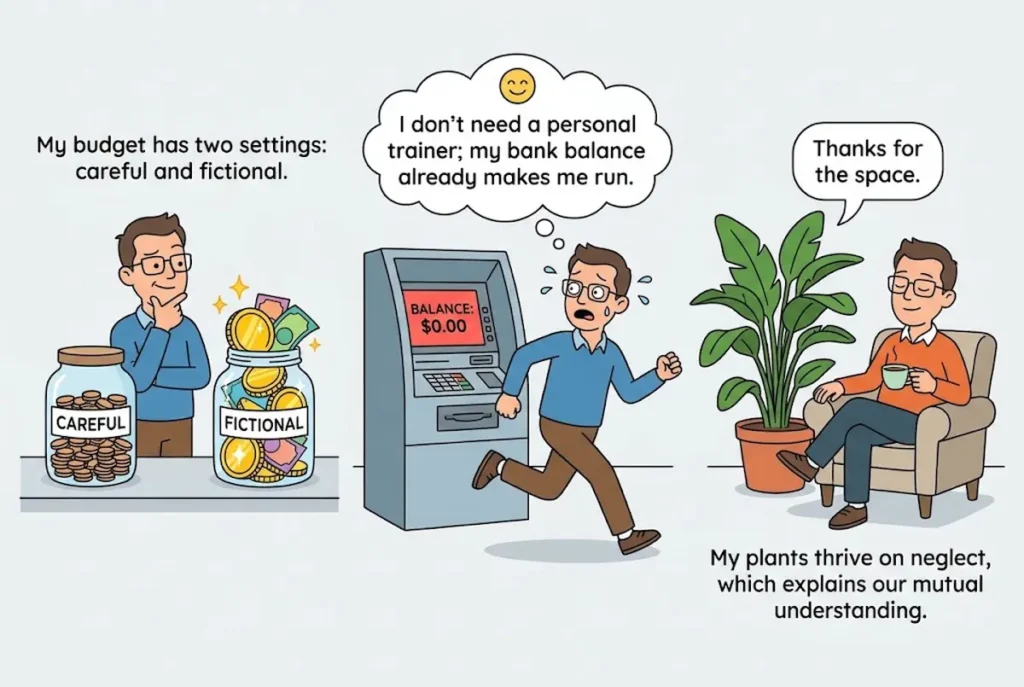
- My budget has two settings: careful and fictional.
- I don’t need a personal trainer; my bank balance already makes me run.
- My plants thrive on neglect, which explains our mutual understanding.
- I have a photographic memory, but the pictures are all blurry.
- My favorite subject is history because it proves that deadlines aren’t new.
- I joined a gym for the atmosphere and stayed for the air-conditioning.
- I’m great at giving advice, especially advice I never follow.
- My password is so secure that even I can’t get into my life.
- I like long walks, particularly when they lead to a bakery.
- My wallet is on a strict diet: no cash after payday.
- I practice mindfulness by remembering every embarrassing thing I’ve ever said.
- My favorite part of teamwork is watching someone else open the spreadsheet.
- I have a six-pack, but it’s hidden behind a very committed snack policy.
- I don’t argue with myself; I hold internal debates with poor moderation.
- My morning routine is mostly negotiations with gravity.
- I bought a smart speaker, and now my furniture has opinions.
- I’m not indecisive; I just appreciate every wrong option equally.
- My inbox has more suspense than a detective novel.
- I set ambitious goals so I can admire them from a distance.
- My cooking has a surprise ending, usually involving takeaway.
- I don’t chase success; I prefer to send it a polite email.
- My calendar is full, but my productivity has left the building.
- I wanted a minimalist lifestyle, so I minimized my bank balance.
- My talent is turning five-minute tasks into full-length documentaries.
Pro Tip: Read each one-liner aloud. Remove any word that doesn’t improve the meaning, rhythm, or surprise. The shorter version often delivers the stronger laugh.
How to Write Jokes Using Puns and Wordplay
Puns create humor by using words with multiple meanings or similar sounds. They’re especially useful for short jokes, greeting cards, captions, and playful conversations. Start with a word that has two meanings, then build a punchline around the less expected one.
- I used to be a banker, but I lost interest.
- The bicycle couldn’t stand on its own because it was two-tired.
- The calendar’s days are numbered.
- I wanted to become a baker, but I couldn’t raise the dough.
- The musician got locked out because he lost his keys.
- The gardener was outstanding in his field.
- I tried writing a joke about a pencil, but it missed the point.
- The electrician was shocked by the news.
- The mathematician was average at everything.
- The scarecrow won an award because he was outstanding in his field.
- The orange stopped halfway down the hill because it ran out of juice.
- The computer went to the doctor because it had a virus.
- The tailor was happy because his career suited him.
- The baker’s career was rising, but he still needed to make more dough.
- The photographer had a bright future because everything was developing.
- The librarian was booked all weekend.
- The comedian opened a bakery because he knew how to deliver a good roll.
- The gardener planted a joke, but it never grew on anyone.
- The clock was hungry, so it went back four seconds.
- The astronaut’s career took off, although his humor was a little spacey.
Pro Tip: Pick a familiar word such as light, bank, date, or note. Write down two meanings, then create a sentence that connects them in an unexpected way.
How to Write Jokes With Exaggeration
Exaggeration makes a small problem sound enormous. Writers use it to make everyday experiences more dramatic, ridiculous, and memorable. The key is to stretch the truth far enough to surprise people while keeping the underlying situation recognizable.
- My to-do list is so long it needs its own table of contents.
- I waited so long for my food that the waiter started asking me for life advice.
- My suitcase is so heavy it qualifies as a gym membership.
- My alarm rings so early that even the sun asks for five more minutes.
- My inbox has so many emails that archaeologists may discover it someday.
- I drank so much coffee that my shadow started vibrating.
- My room is so messy that my socks have formed a search-and-rescue team.
- My internet is so slow that loading a page counts as a long-term investment.
- My neighbor plays music so loudly that my furniture knows every lyric.
- I have so many unfinished projects that my desk needs a traffic controller.
- My grocery bill was so high that the cashier offered me financial counseling.
- My dog snores so loudly that the neighbors think we run a small construction company.
- My phone battery drains so quickly that I charge it during commercial breaks.
- My coffee was so strong that my spoon started doing push-ups.
- I slept so late that breakfast introduced itself as lunch.
- My garden has so many weeds that the flowers are considering a relocation.
- My shopping cart was so full that it requested overtime pay.
- I took such a long nap that my dreams needed a season finale.
- My computer has so many tabs open that it needs a building manager.
- My cooking was so memorable that the smoke detector gave a standing ovation.
Pro Tip: Take a minor inconvenience and ask, “What if this were ten times worse?” Then push the situation one step further. Keep the exaggeration connected to the original problem so the audience can follow the joke.
How to Write Jokes About Work and Office Life
Work provides endless material for observational comedy: meetings that could have been emails, printers that refuse to cooperate, and coffee breaks that become strategic planning sessions. Relatable office humor works best when it targets common situations rather than humiliating an individual.
- Our meeting was so productive that we scheduled another meeting to discuss it.
- My computer froze during a presentation. Even it needed a break.
- The office printer only works when someone threatens to replace it.
- I put “excellent multitasking” on my résumé because I can worry about six deadlines simultaneously.
- My inbox has promoted itself to my full-time supervisor.
- The office coffee is so strong it can restart a forgotten password.
- I asked for flexible hours, and my boss gave me a rubber band.
- My desk calendar is full of deadlines and empty promises.
- We had a brainstorming session, but everyone brought umbrellas.
- My spreadsheet has more drama than the office television.
- The team-building exercise ended when everyone agreed to work separately.
- I finished my report early, so my reward was another report.
- The office chair knows more about my career than my manager does.
- My work-life balance is currently being investigated.
- The email subject said “Quick Question.” It came with twelve attachments.
- Our office plant has witnessed every deadline and still refuses to grow.
- I asked the printer for help. It gave me a blank page.
- The company introduced a wellness program, starting with a meeting about stress.
- My vacation request is pending so long that the holiday may become historical.
- I don’t avoid office gossip; I simply prefer professionally sourced rumors.
Pro Tip: Turn your own harmless workplace observations into jokes, but avoid confidential information and personal attacks. A funny caption about meetings can unite coworkers without making anyone the punchline.

How to Write Jokes for Social Media and Captions
Social media jokes need to grab attention quickly. A short setup, a relatable observation, or an unexpected final phrase can work well in captions, memes, and short videos. Keep each line easy to read on a phone screen.
- My weekend plans include doing nothing with impressive commitment.
- Adulting is mostly searching for something you were holding five seconds ago.
- I came for one snack and left with a grocery-store documentary.
- My camera roll has more pictures of food than pictures of me.
- Current status: emotionally invested in my delivery tracking page.
- My fitness tracker says I need more steps, so I walked to the refrigerator twice.
- I don’t need a filter; I need eight hours of sleep.
- My shopping cart is full of things my budget never approved.
- Today I achieved my goal of making a list of goals.
- My Wi-Fi password is the most important relationship in my home.
- I posted a motivational quote and then ignored it immediately.
- My plants have a better daily routine than I do.
- I bought a journal to organize my thoughts. Now I have a notebook full of confusion.
- My favorite notification is the one that says my food has arrived.
- I treat every minor inconvenience like a season finale.
- My bank account and I are taking some time apart.
- I wanted to post something profound, but my snack arrived.
- My camera loves me; my front-facing camera prefers honesty.
- I put the “pro” in procrastination, then postponed the celebration.
- If laughter is the best medicine, my group chat deserves a prescription.
Pro Tip: Match your caption to the photo or video. Put the key punchline near the end, use short sentences, and read the post aloud before publishing to check its rhythm.
How to Write Jokes About Family and Relationships
Family jokes often work because people recognize the little habits that make home life memorable. Use affection, mild exaggeration, and familiar situations to create humor that brings people together instead of embarrassing them.
- My family doesn’t need a group chat; we need a customer support department.
- My dad tells the same jokes so often that even the punchlines arrive early.
- My mom can find anything except the remote when she’s already holding it.
- Family dinner is where everyone discusses food while eating something different.
- My sibling borrowed my charger and has now entered witness protection.
- My partner asked me to listen more carefully, so I turned on subtitles.
- Our family calendar looks like a puzzle designed by a tired accountant.
- My parents say I should save money, then ask why I never visit.
- My dog gets more compliments at family gatherings than I do.
- My family photo took twenty minutes because nobody agreed on where to look.
- My brother says he is always right, which is a remarkable achievement for someone who loses his keys daily.
- My partner and I share everything, including the blame when dinner burns.
- My grandmother’s recipes have no measurements, only strong opinions.
- Family road trips teach patience, geography, and how to survive one more snack stop.
- My dad calls technology confusing, then fixes my Wi-Fi without reading the instructions.
- My family has a special talent for turning a five-minute visit into a three-hour event.
- My partner says I never make decisions. I told them we’d discuss it later.
- My mother doesn’t need a weather app; she can predict rain by looking at the laundry.
- Our family game night ends when someone starts explaining the rules again.
- Love means accepting someone’s habits, even when they squeeze the toothpaste from the wrong end.
Pro Tip: Use family humor in birthday cards, anniversary messages, or group chats. Choose details that show affection, and avoid subjects that could reopen an old argument.
How to Write Jokes With Funny Questions and Answers
Question-and-answer jokes invite participation. The setup gives the audience a small puzzle, while the answer provides a pun, an unexpected connection, or a silly twist. They’re particularly useful for children, classroom activities, and quick icebreakers.
- Why did the math book look worried? It had too many problems.
- What do you call a sleeping bull? A bulldozer.
- Why did the computer go to the doctor? It had a virus.
- What kind of music do balloons hate? Pop music.
- Why did the tomato blush? It saw the salad dressing.
- What do you call a bear with no teeth? A gummy bear.
- Why did the student eat the homework? The teacher said it was a piece of cake.
- What do you call a fish wearing a bow tie? Sofishticated.
- Why can’t your nose be twelve inches long? Because then it would be a foot.
- What did one wall say to the other? “I’ll meet you at the corner.”
- Why did the cookie visit the doctor? It was feeling crumby.
- What do you call a dinosaur with excellent vocabulary? A thesaurus.
- Why did the bicycle fall over? It was two-tired.
- What do you call a group of musical whales? An orca-stra.
- Why did the pencil go to school? It wanted to get sharper.
- What did the ocean say to the beach? Nothing; it just waved.
- Why did the banana visit the doctor? It wasn’t peeling well.
- What do you call a fake noodle? An impasta.
- Why did the clock get sent to the principal? It kept tocking in class.
- What do you call cheese that isn’t yours? Nacho cheese.
Pro Tip: Use the setup as a quiz and let your audience guess the answer before revealing it. For children, pause long enough for them to solve the riddle, then explain any wordplay they may not know.
How to Write Jokes About Mistakes and Awkward Moments
Embarrassing moments can become funny stories when you give them a lighthearted twist. Focus on the situation, your own reaction, or the difference between what you intended and what actually happened.
- I waved back at someone who wasn’t waving at me. We are now both committed to the friendship.
- I walked into a room and forgot why I went there. The room also seemed confused.
- I said “you too” when the waiter told me to enjoy my meal.
- I practiced my introduction so well that I forgot it when someone said hello.
- I tried to look busy when my boss walked past, so I opened a spreadsheet I didn’t understand.
- I smiled at a stranger because I thought I knew them. Now we’re both wondering who started it.
- I sent a message to the wrong group chat and discovered a new definition of suspense.
- I confidently gave directions, then followed someone else to find the destination.
- I rehearsed a phone call for ten minutes and still forgot my opening line.
- I tripped over nothing and immediately blamed the floor.
- I tried to whisper a secret, but my whisper had a public announcement system.
- I opened the front camera by accident and learned humility in high definition.
- I walked into a shop, forgot what I wanted, and bought a snack as evidence of productivity.
- I said goodbye, then walked in the same direction as the person I was leaving.
- I told a joke that nobody understood, so I laughed to protect the investment.
- I confidently spelled a word incorrectly while correcting someone else.
- I pretended to understand a complicated explanation and accidentally agreed to help.
- I looked for my glasses while wearing them. My search was very well focused.
- I practiced a dance move alone, then forgot how legs worked when someone watched.
- I tried to act natural in a photo and somehow looked like a passport application.
Pro Tip: Write down an awkward moment and describe it in three stages: what you expected, what happened, and what made it funny afterward. Keep the story brief and let the final detail deliver the laugh.
How to Practice Joke Writing and Improve Your Punchlines
Writing better jokes takes practice, editing, and feedback. You can learn a great deal by testing different endings, studying comic timing, and revising lines that take too long to reach the point. Use these examples as prompts for your own material.
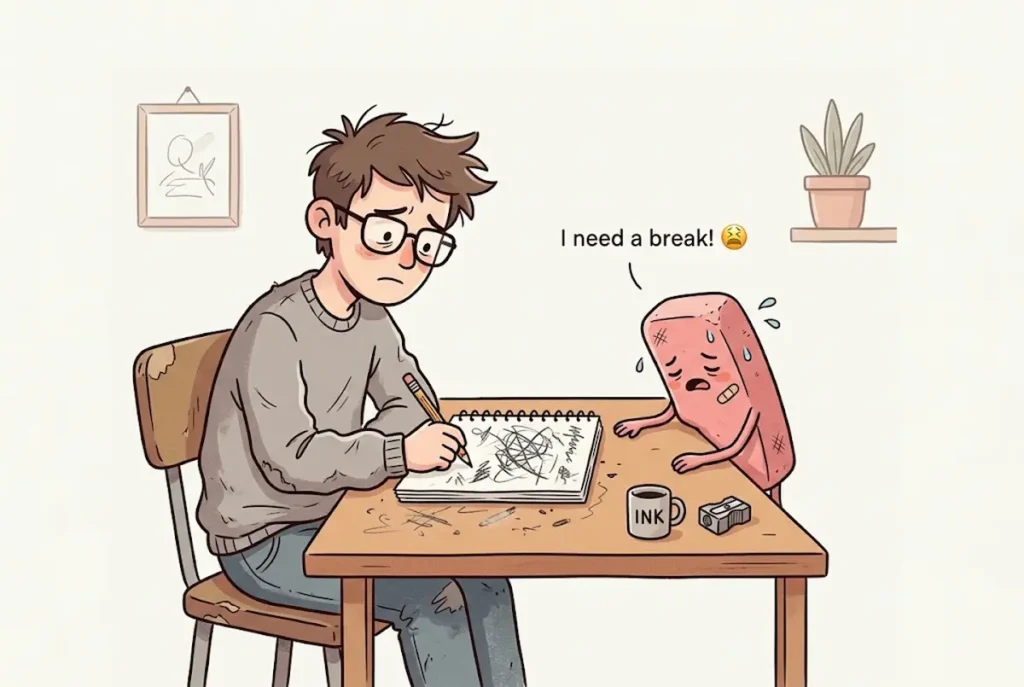
- My first draft was so rough that even the eraser asked for a break.
- I joined a comedy workshop to improve my timing, but I arrived a day late.
- My notebook is full of jokes; my audience is still under review.
- I tested a punchline on my mirror, and the feedback was mixed.
- My joke-writing routine begins with coffee and ends with more coffee.
- I rewrote my best joke twelve times. The first version was still the shortest.
- My editor told me to cut the unnecessary words. We now communicate with nods.
- I practiced my delivery in the car, and the traffic lights gave me a captive audience.
- I asked a friend for honest feedback. They sent me a laughing emoji and changed the subject.
- My comedy notebook has a section called “Needs Work” and another called “Needs More Work.”
- I studied comic timing, then waited three days before telling the joke.
- My joke was almost perfect, but the punchline needed a little editing.
- I wrote ten jokes in an hour and kept the one that made me laugh on the second reading.
- My comedy mentor said to trust the audience, so I stopped explaining every punchline.
- I learned to cut weak endings; my jokes are now on a word budget.
- I tried a new joke at dinner, and the silence gave me valuable research data.
- My writing group suggested a stronger ending. We finally agreed on the beginning.
- I keep a list of funny phrases because inspiration rarely respects office hours.
- I record my ideas before bed, then wonder who wrote them the next morning.
- I improved my joke by removing the explanation. The audience finally got the point.
Pro Tip: Try a seven-day joke-writing challenge. Write five jokes each day, revise your two strongest lines, and share one with a trusted friend. Track which setups get a laugh and which ones need a sharper ending.
Conclusion
Learning how to write jokes becomes easier when you break comedy into manageable skills: observe everyday life, build a clear setup, create an unexpected punchline, and edit until every word earns its place. Puns, exaggeration, relatable stories, and funny questions all give you useful ways to make people laugh.
Remember, you don’t need every joke to work. Even experienced humor writers revise their material, test different endings, and learn from audience reactions. Keep a notebook, practice regularly, and pay attention to the small details that other people overlook. Your next great punchline might be hiding in your morning routine or your latest shopping trip!
Which joke-writing technique will you try first? Share your favorite example in the comments, send this guide to a friend who loves comedy, or save it for your next writing session.
Frequently Asked Questions (FAQs)
How do beginners learn how to write jokes?
Start by observing everyday situations, writing short setups, and experimenting with unexpected endings. Practice with puns, exaggeration, and relatable experiences, then revise your jokes based on feedback.
What are the three main parts of a joke?
Many jokes use a setup, a punchline, and delivery. The setup establishes an expectation, the punchline changes it, and delivery—including timing and pauses—helps the audience understand the humor.
How do you make a joke funnier?
Use a clear setup, remove unnecessary words, and make the ending surprising but understandable. Read the joke aloud and test different punchlines to discover which version works best.
How do you write a short joke?
Focus on one idea and one unexpected twist. Remove extra details, use familiar language, and place the strongest word or phrase at the end whenever possible.
How can I write jokes for social media?
Use relatable experiences, short captions, simple wordplay, and punchlines that readers can understand quickly. Match the joke to the image or video and consider whether it suits your audience.
How do comedians come up with jokes?
Comedians often collect observations, explore unusual connections, exaggerate common experiences, and experiment with different endings. They revise their material and test it in front of audiences.
What makes a joke fall flat?
A joke may fail because the setup is confusing, the punchline is predictable, the wording is too long, or the audience lacks the context. Sometimes the timing or audience simply isn’t right.
How often should I practice writing jokes?
Daily practice is a useful starting point. Try writing five short jokes a day, revising your strongest ideas, and sharing selected examples with people who enjoy humor.
