
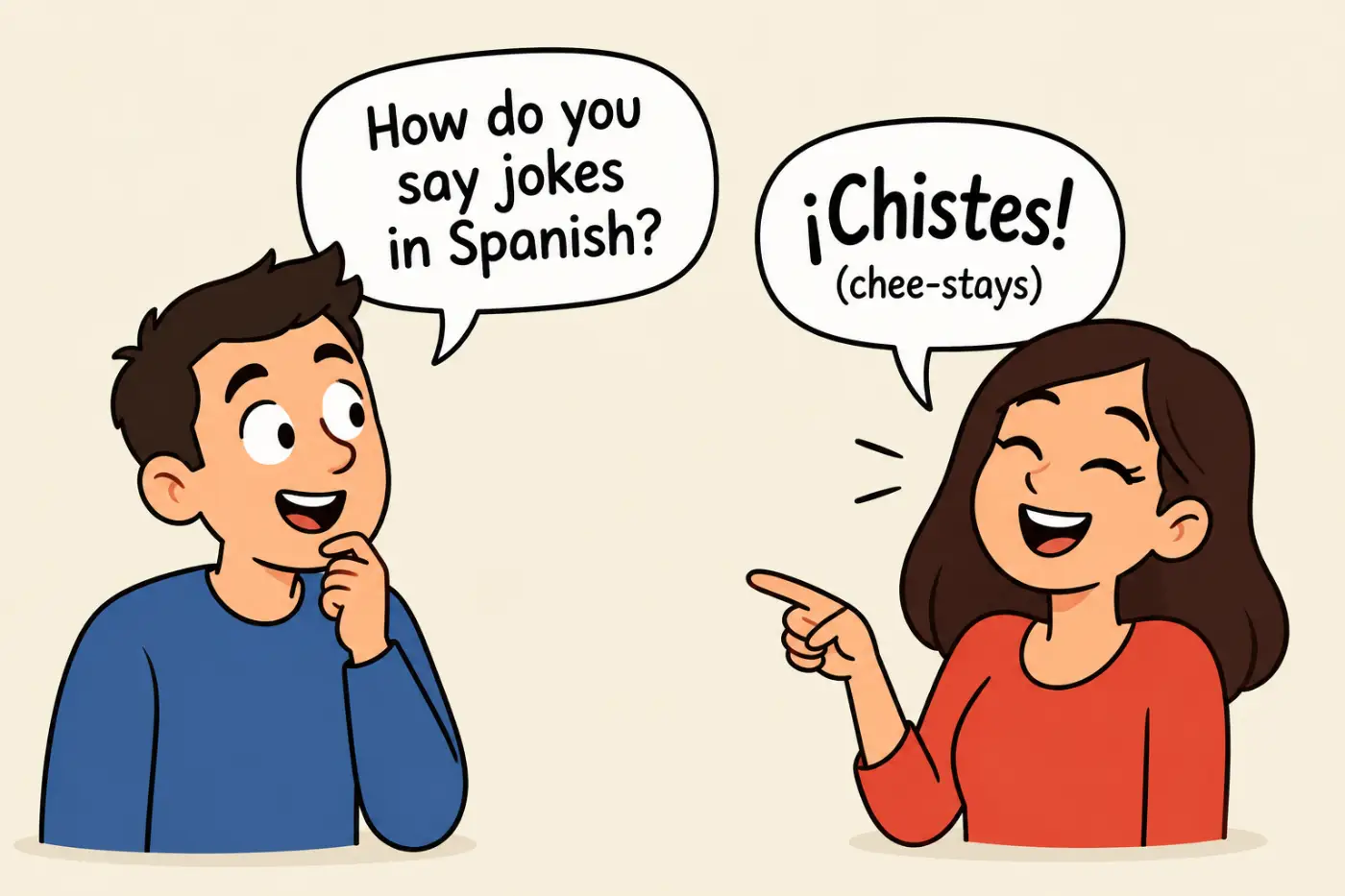
How do you say jokes in Spanish? The answer is chistes! One little Spanish word opens the door to funny conversations, clever wordplay, and plenty of opportunities to make your Spanish-speaking friends smile.
Whether you’re learning Spanish for travel, chatting with friends, studying a new language, or simply collecting giggles to share online, knowing a few funny chistes en español makes conversations more enjoyable. You’ll also discover useful vocabulary, simple phrases, and jokes that are easy to remember.
In this guide, you’ll find puns with English translations, beginner-friendly puns, playful questions, and language-learning humor. Some jokes work through wordplay, while others use familiar situations. Ready to turn ¿Qué tal? into ¡Qué risa!? Let’s get started!
How Do You Say “Jokes” in Spanish?
The word for “puns” is chistes, while one joke is un chiste. If you want to ask someone how to say a word in Spanish, you can use “¿Cómo se dice… en español?”
- English: Tell me a joke.
Spanish: Cuéntame un chiste. - English: Tell me another joke.
Spanish: Cuéntame otro chiste. - English: That’s funny!
Spanish: ¡Qué gracioso! - English: I’m joking.
Spanish: Estoy bromeando. - English: Just kidding!
Spanish: ¡Es broma! - English: Do you know any jokes?
Spanish: ¿Sabes algún chiste? - English: I love jokes.
Spanish: Me encantan los chistes. - English: That’s a good joke.
Spanish: Es un buen chiste. - English: That joke made me laugh.
Spanish: Ese chiste me hizo reír. - English: Can you tell it again?
Spanish: ¿Puedes contarlo otra vez? - English: I don’t understand the joke.
Spanish: No entiendo el chiste. - English: What’s the punchline?
Spanish: ¿Cuál es el remate? - English: That’s hilarious!
Spanish: ¡Es divertidísimo! - English: He tells funny jokes.
Spanish: Él cuenta chistes graciosos. - English: She has a great sense of humor.
Spanish: Ella tiene un gran sentido del humor. - English: This joke is easy to remember.
Spanish: Este chiste es fácil de recordar. - English: Do you like funny stories?
Spanish: ¿Te gustan las historias divertidas? - English: Let’s laugh together.
Spanish: Vamos a reírnos juntos.
Pro Tip: Save these phrases in your phone. When someone asks you to tell a joke in Spanish, you’ll have the vocabulary ready before the punchline arrives.
Easy Jokes for Beginners
Learning Spanish doesn’t need to be all textbooks and verb charts. These short jokes use simple vocabulary and familiar situations, so beginners can practice reading, pronunciation, and comprehension.
- ¿Qué hace una abeja en el gimnasio?
¡Zum-ba!
What does a bee do at the gym? It does Zumba!
(The Spanish “zum” imitates a bee’s buzz.) - ¿Qué le dice un techo a otro techo?
Techo de menos.
What does one roof say to another? I miss you.
(A play on “te echo de menos,” meaning “I miss you.”) - ¿Qué hace una vaca cuando sale el sol?
Sombra.
What does a cow do when the sun comes out? It makes shade.
(A playful answer using “sombra,” or “shade.”) - ¿Qué le dijo un pez a otro pez?
¡Nada!
What did one fish say to another? Nothing!
(“Nada” can mean “nothing” or “swims.”) - ¿Qué hace una computadora cuando tiene frío?
Cierra las ventanas.
What does a computer do when it’s cold? It closes the windows. - ¿Cuál es el colmo de un jardinero?
Que siempre lo dejen plantado.
What’s a gardener’s worst luck? Always being stood up.
(“Plantado” can refer to being left waiting.) - ¿Qué le dice una pared a otra?
Nos vemos en la esquina.
What does one wall say to another? See you at the corner. - ¿Por qué el libro fue al médico?
Porque tenía muchas páginas en blanco.
Why did the book visit the doctor? It had too many blank pages.
Pro Tip: Read each Spanish joke aloud, then cover the English translation and try to explain the punchline yourself. That way, you’re practicing Spanish and comedy at the same time.
Funny Spanish Food Jokes and Puns
Food is an easy topic for language learners because many words appear on menus, in kitchens, and during everyday conversations. These chistes de comida pair familiar ingredients with silly situations and simple Spanish vocabulary.
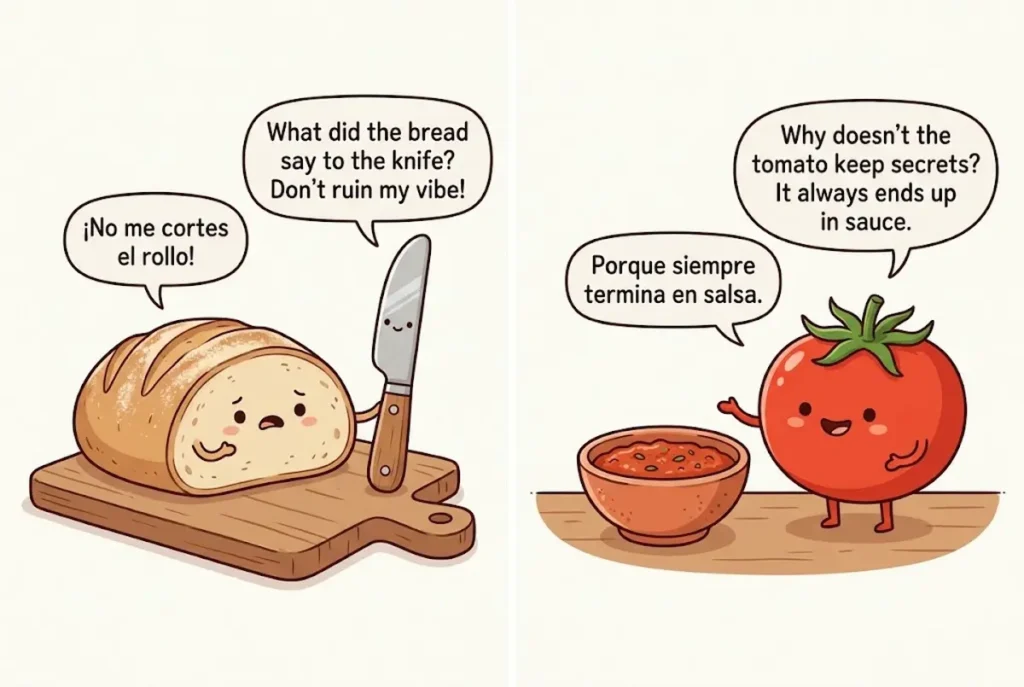
- ¿Qué le dijo el pan al cuchillo?
¡No me cortes el rollo!
What did the bread say to the knife? Don’t ruin my vibe!
(“Cortar el rollo” is an informal expression for spoiling the mood.) - ¿Por qué el tomate no cuenta secretos?
Porque siempre termina en salsa.
Why doesn’t the tomato keep secrets? It always ends up in sauce. - ¿Qué hace el queso cuando cuenta un secreto?
Lo dice en voz baja para que no se derrita la confianza.
What does cheese do when sharing a secret? It whispers so trust doesn’t melt. - ¿Por qué la sopa fue a terapia?
Porque tenía demasiadas cosas en la olla.
Why did the soup go to therapy? It had too much going on in the pot. - ¿Qué le dijo el arroz al frijol?
¡Juntos hacemos un gran equipo!
What did the rice say to the bean? Together, we’re a great team! - ¿Por qué el huevo no discutía?
Porque no quería romper la calma.
Why didn’t the egg argue? It didn’t want to crack the peace. - ¿Qué hace una papa cuando está aburrida?
Se convierte en patata frita para animar el día.
What does a potato do when bored? Turns into a French fry to brighten the day. - ¿Por qué el café fue al psicólogo?
Porque estaba muy cargado.
Why did the coffee visit a psychologist? Because it was heavily loaded.
(“Cargado” can describe strong coffee.)
Pro Tip: Pick three food puns and practice them before ordering at a Spanish-speaking restaurant. The goal isn’t perfect stand-up comedy; it’s making conversation while learning useful words.
Animal Jokes That Make You Laugh
Animal jokes are a useful way to remember nouns and verbs. From cats hunting computer mice to bees buzzing through the gym, these playful chistes de animales give everyday vocabulary a funny twist.
- ¿Qué hace una abeja en el gimnasio?
¡Zum-ba!
What does a bee do at the gym? Zumba! - ¿Qué le dijo el perro al árbol?
¡Qué buen palo!
What did the dog say to the tree? What a great stick! - ¿Por qué el gato se sentó frente al ordenador?
Porque quería atrapar el ratón.
Why did the cat sit in front of the computer? It wanted to catch the mouse. - ¿Qué hace un pez en una oficina?
Nada, pero con mucha profesionalidad.
What does a fish do in an office? Nothing—but very professionally. - ¿Por qué el caballo abrió una cuenta bancaria?
Para guardar sus ahorros al galope.
Why did the horse open a bank account? To save at a gallop. - ¿Qué le dijo la vaca al ternero?
¡No te preocupes, todo saldrá muuuuy bien!
What did the cow say to the calf? Don’t worry, everything will go mooo-velously! - ¿Por qué el búho estudia de noche?
Porque es un ave nocturna y no quiere perder clase.
Why does the owl study at night? It’s a night bird and doesn’t want to miss class. - ¿Qué hace una tortuga cuando tiene prisa?
Se toma su tiempo, pero con determinación.
What does a turtle do when in a hurry? Takes its time, but with determination.
Pro Tip: Turn these into vocabulary flashcards. Put the Spanish joke on one side and its English meaning on the other, then practice with a language partner.
School and Student Jokes
School jokes make language learning easier because they feature classrooms, homework, teachers, and exams—topics most learners already understand. Read the Spanish first, then check the translation to see how each punchline works.
- Profesor: ¿Por qué llegaste tarde?
Alumno: Porque el cartel decía “Escuela adelante” y seguí caminando.
Teacher: Why were you late? Student: The sign said “School ahead,” so I kept walking. - ¿Por qué el libro de matemáticas estaba triste?
Porque tenía demasiados problemas.
Why was the math book sad? It had too many problems. - ¿Qué hace un lápiz en un examen?
Da respuestas puntiagudas.
What does a pencil do on an exam? Gives pointed answers. - ¿Por qué el estudiante llevó una escalera a clase?
Porque quería sacar notas más altas.
Why did the student bring a ladder to class? To get higher grades. - ¿Qué le dijo el cero al ocho?
¡Qué cinturón tan elegante!
What did zero say to eight? What an elegant belt! - ¿Por qué la regla siempre dice la verdad?
Porque mide cada palabra.
Why does the ruler always tell the truth? It measures every word. - ¿Por qué el diccionario es tan popular?
Porque siempre tiene la última palabra.
Why is the dictionary so popular? It always gets the last word. - ¿Qué hace el borrador cuando se equivoca?
Intenta borrar el pasado.
What does the eraser do when it makes a mistake? Tries to erase the past.
Pro Tip: Use one joke as a warm-up before Spanish practice. Ask a learner to identify the key vocabulary, explain the punchline, and then create a new joke using the same words.
Spanish Animal Puns and Wordplay
Animal jokes can help you remember vocabulary while enjoying some silly punchlines. These short chistes de animales mix familiar creatures with playful expressions that are easy to share.
- ¿Qué hace un gato en una tienda de informática? Busca el ratón.
What does a cat do in a computer store? Looks for the mouse. - ¿Qué le dijo el pato a la pata? ¡Vamos a dar una vuelta!
What did the duck say to the female duck? Let’s go for a walk! - ¿Por qué el perro se sentó junto al teléfono? Esperaba una llamada de su dueño.
Why did the dog sit beside the phone? It was waiting for its owner’s call. - ¿Cuál es el animal más antiguo? La cebra, porque está en blanco y negro.
What’s the oldest animal? The zebra, because it’s in black and white. - ¿Qué hace un pez mago? ¡Nada por aquí, nada por allá!
What does a fish magician do? Nothing here, nothing there! - ¿Por qué el caballo fue a la biblioteca? Quería leer una historia de carreras.
Why did the horse go to the library? It wanted to read a racing story. - ¿Qué animal siempre llega tarde? El caracol, porque va a paso lento.
Which animal is always late? The snail, because it moves slowly. - ¿Por qué el león no juega a las escondidas? Porque siempre se convierte en el rey de la selva.Why doesn’t the lion play hide-and-seek? Because it always ends up as king of the jungle
Pro Tip: Choose three animal jokes and challenge a friend to translate them without looking at the English. Then compare answers and discuss the funniest wordplay.
Knock-Knock Jokes and Question-and-Answer Humor
Knock-knock jokes aren’t always translated word for word because uses different sounds and expressions.
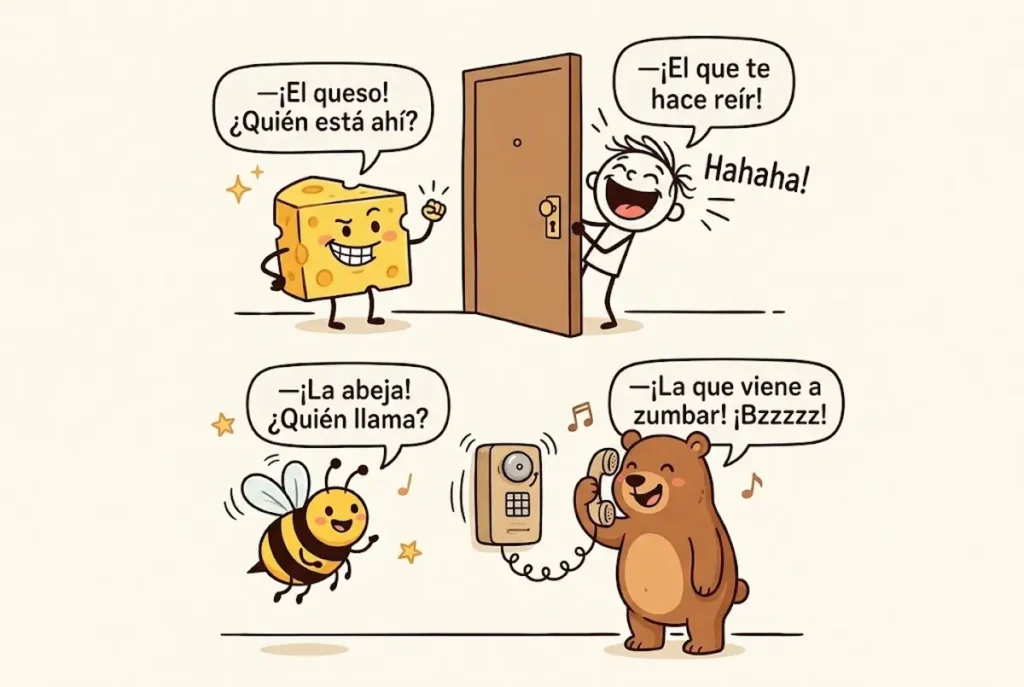
- —¿Quién está ahí? —El queso. —¿Qué queso? —¡El que te hace reír!
Who’s there? Cheese. What cheese? The cheese that makes you laugh! - —¿Quién llama? —La abeja. —¿Qué abeja? —¡La que viene a zumbar!
Who’s calling? The bee. Which bee? The one coming to buzz! - —¿Quién está ahí? —El libro. —¿Qué libro? —¡El que tiene un final inesperado!
Who’s there? The book. Which book? The one with an unexpected ending! - —¿Quién llama? —El gato. —¿Qué gato? —¡El que quiere entrar al chat!
Who’s calling? The cat. Which cat? The one that wants to join the chat! - —¿Quién está ahí? —La sopa. —¿Qué sopa? —¡La que está caliente con este chiste!
Who’s there? The soup. Which soup? The one getting heated by this joke! - —¿Quién llama? —El pato. —¿Qué pato? —¡El que viene a contar un cuac-chiste!
Who’s calling? The duck. Which duck? The one here to tell a quack joke! - —¿Quién está ahí? —La luna. —¿Qué luna? —¡La que ilumina mis malos chistes!
Who’s there? The moon. Which moon? The one lighting up my bad jokes! - —¿Quién llama? —El café. —¿Qué café? —¡El que despierta la conversación!
Who’s calling? The coffee. Which coffee? The one that wakes up the conversation!
Pro Tip: Spanish knock-knock humor works best when you act out both sides of the conversation. Use different voices for each speaker and explain any wordplay that doesn’t translate directly.
Jokes About Love and Relationships
Love and dating provide endless material for playful Spanish jokes. These short lines use familiar romantic situations, affectionate teasing, and a few simple expressions you’ll hear in everyday conversation.
- ¿Por qué el enamorado llevó una escalera a la cita? Quería llegar a tu corazón.
Why did the person in love bring a ladder to the date? To reach your heart. - ¿Qué le dijo un corazón a otro? ¡Late que late, contigo no hay empate!
What did one heart say to another? Beat after beat, with you there’s no tie! - ¿Por qué la pareja estudió matemáticas? Para aprender a sumar juntos.
Why did the couple study math? To learn how to add things up together. - ¿Qué le dijo el café a su pareja? ¡Me tienes despierto de amor!
What did the coffee say to its partner? You’ve kept me awake with love! - ¿Qué le dijo una estrella a otra? ¡Contigo, hasta las noches brillan!
What did one star say to another? With you, even nights shine! - ¿Qué hace una pareja de peces? Nada por separado y nada en compañía.
What does a pair of fish do? Swims alone and swims together. - ¿Por qué el teléfono estaba enamorado? Porque siempre esperaba una llamada especial.
Why was the phone in love? It was always waiting for a special call. - ¿Qué le dijo el imán a su pareja? ¡No puedo resistirme a ti!
What did the magnet say to its partner? I can’t resist you!
Pro Tip: Share the sweetest lines with a Spanish-speaking partner or friend. For extra practice, replace the objects in each joke with new Spanish words and create your own romantic punchlines.
Travel Jokes for Your Next Adventure
Travel gives you plenty of chances to use Spanish outside the classroom. These jokes feature airports, hotels, maps, and sightseeing—so you can practice useful travel vocabulary while preparing a few laughs for the journey.
- ¿Por qué el turista llevó una escalera a España? Quería conocer los lugares más altos.
Why did the tourist bring a ladder to Spain? To visit the highest places. - ¿Qué le dijo el mapa al viajero? ¡No pierdas el norte!
What did the map say to the traveler? Don’t lose your north!
(A play on the expression “no perder el norte,” meaning not to lose direction or focus.) - ¿Por qué la maleta estaba cansada? Porque llevaba demasiado equipaje emocional.
Why was the suitcase tired? It was carrying too much emotional baggage. - ¿Por qué el avión fue a la escuela? Para mejorar su nivel de vuelo.
Why did the plane go to school? To improve its flight level. - ¿Qué le dijo el pasaporte a la maleta? ¡Nos vemos en la próxima frontera!
What did the passport say to the suitcase? See you at the next border! - ¿Qué hace un turista con un diccionario? Traduce sus dudas en preguntas.
What does a tourist do with a dictionary? Translates doubts into questions. - ¿Por qué el tren nunca cuenta secretos? Porque todo se sabe por los raíles.
Why doesn’t the train tell secrets? Because everything gets out along the tracks. - ¿Qué dijo el viajero al ver el mar? ¡Esto sí que es una vista de primera ola!
What did the traveler say upon seeing the sea? Now that’s a first-wave view!
Pro Tip: Practice these jokes before a trip and learn the key words for directions, transport, and accommodation. A little humor can help start a friendly conversation, but use clear phrases whenever you need important travel information.
Work and Office Jokes
Workplace humor makes Spanish practice more relatable. These jokes cover meetings, deadlines, emails, and coffee breaks, giving you useful vocabulary for everyday office conversations.
- ¿Por qué el ordenador llegó tarde al trabajo? Porque necesitaba reiniciarse.
Why did the computer arrive late to work? It needed to restart. - ¿Qué le dijo el café al empleado? ¡Sin mí, esta reunión no arranca!
What did the coffee say to the employee? Without me, this meeting won’t get started! - ¿Por qué el calendario es el empleado más ocupado? Porque tiene todos los días llenos.
Why is the calendar the busiest employee? Because all its days are full. - ¿Qué hace un lápiz durante una reunión? Toma notas afiladas.
What does a pencil do during a meeting? Takes sharp notes. - ¿Por qué el jefe llevó una escalera a la oficina? Quería subir el nivel del equipo.
Why did the boss bring a ladder to the office? To raise the team’s level. - ¿Qué le dijo el correo electrónico al empleado? ¡Tienes un mensaje pendiente!
What did the email say to the employee? You have a message waiting! - ¿Por qué la impresora estaba estresada? Porque tenía demasiadas hojas de trabajo.
Why was the printer stressed? It had too many worksheets. - ¿Qué hace un reloj en la oficina? Cuenta las horas hasta el descanso.
What does a clock do at the office? Counts the hours until break time.
Pro Tip: Share one office joke during an informal break or Spanish study group. Avoid jokes that target a coworker’s performance, background, or personal circumstances.
Spanish Puns and Funny One-Liners for Social Media
Need a short Spanish caption for a meme, a travel photo, or a funny post? These compact lines combine simple expressions and playful observations. Each translation helps you understand the meaning before sharing it.
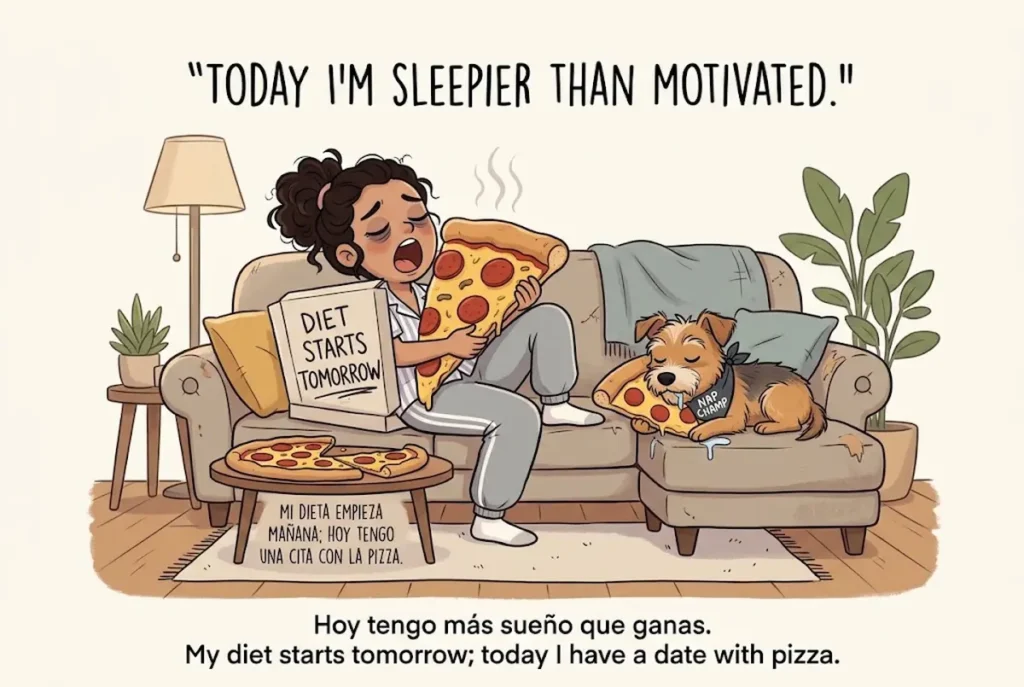
- Hoy tengo más sueño que ganas.
Today I’m sleepier than motivated. - Mi dieta empieza mañana; hoy tengo una cita con la pizza.
My diet starts tomorrow; today I have a date with pizza. - No soy lento, voy en modo ahorro de energía.
I’m not slow; I’m in power-saving mode. - Mi café necesita un café.
My coffee needs a coffee. - La vida es corta: pide el postre.
Life is short: order dessert. - Estoy en una relación seria con mi almohada.
I’m in a serious relationship with my pillow. - No procrastino; dejo que las ideas maduren.
I don’t procrastinate; I let ideas mature. - Mi cartera y yo necesitamos hablar de nuestros gastos.
My wallet and I need to talk about our spending. - Sonríe: hoy también cuenta como experiencia.
Smile: today counts as experience too. - Mi talento oculto es olvidar por qué entré en una habitación.
My hidden talent is forgetting why I entered a room. - Estoy aprendiendo español para discutir con mi GPS en dos idiomas.
I’m learning Spanish so I can argue with my GPS in two languages. - La paciencia es una virtud; esperar la comida es una prueba.
Patience is a virtue; waiting for food is a test.
Pro Tip: Use Spanish captions alongside an English translation when your audience includes language learners. Keep the wording short, and double-check regional expressions before using them in a public post.
Conclusion
Now you know the answer to “how do you say jokes in Spanish?” The word is chistes, and a single joke is un chiste. You can ask someone to tell you a joke with Cuéntame un chiste, or ask whether they know any jokes by saying ¿Sabes algún chiste?
From animal puns and food puns to travel humor and office one-liners offer a playful way to build vocabulary and start conversations. Remember that wordplay doesn’t always translate exactly, so understanding the meaning is just as important as memorizing the words.
Which Spanish joke was your favorite? Share it with a friend, practice the punchline with a language partner, or leave a comment with a chiste of your own. ¡A reírse se ha dicho!—Let’s get laughing!
Frequently Asked Questions (FAQs)
How do you say “Tell me a joke” in Spanish?
Say “Cuéntame un chiste.” You can use this informal phrase with friends, family, or people you know well. A more formal version is “Cuénteme un chiste.”
How do you say “I’m joking” in Spanish?
You can say “Estoy bromeando” to mean “I’m joking.” You can also use “Es broma,” which means “It’s a joke” or “Just kidding.”
What is a funny joke in Spanish for beginners?
A popular short example is: “¿Qué le dijo un pez a otro pez? ¡Nada!” It means, “What did one fish say to another? Nothing!” The humor comes from nada, which can mean “nothing” or “swims,” depending on context.
How can I learn Spanish with jokes?
Read a short joke in Spanish, listen to its pronunciation if possible, study unfamiliar words, and try explaining the punchline in English. Then repeat the joke without looking at the translation and practice using its vocabulary in a new sentence.
What is the difference between “chiste” and “broma”?
A chiste is usually a joke told for humor. A broma often refers to a prank, a teasing remark, or a joke played on someone. The words sometimes overlap, depending on the situation.
