
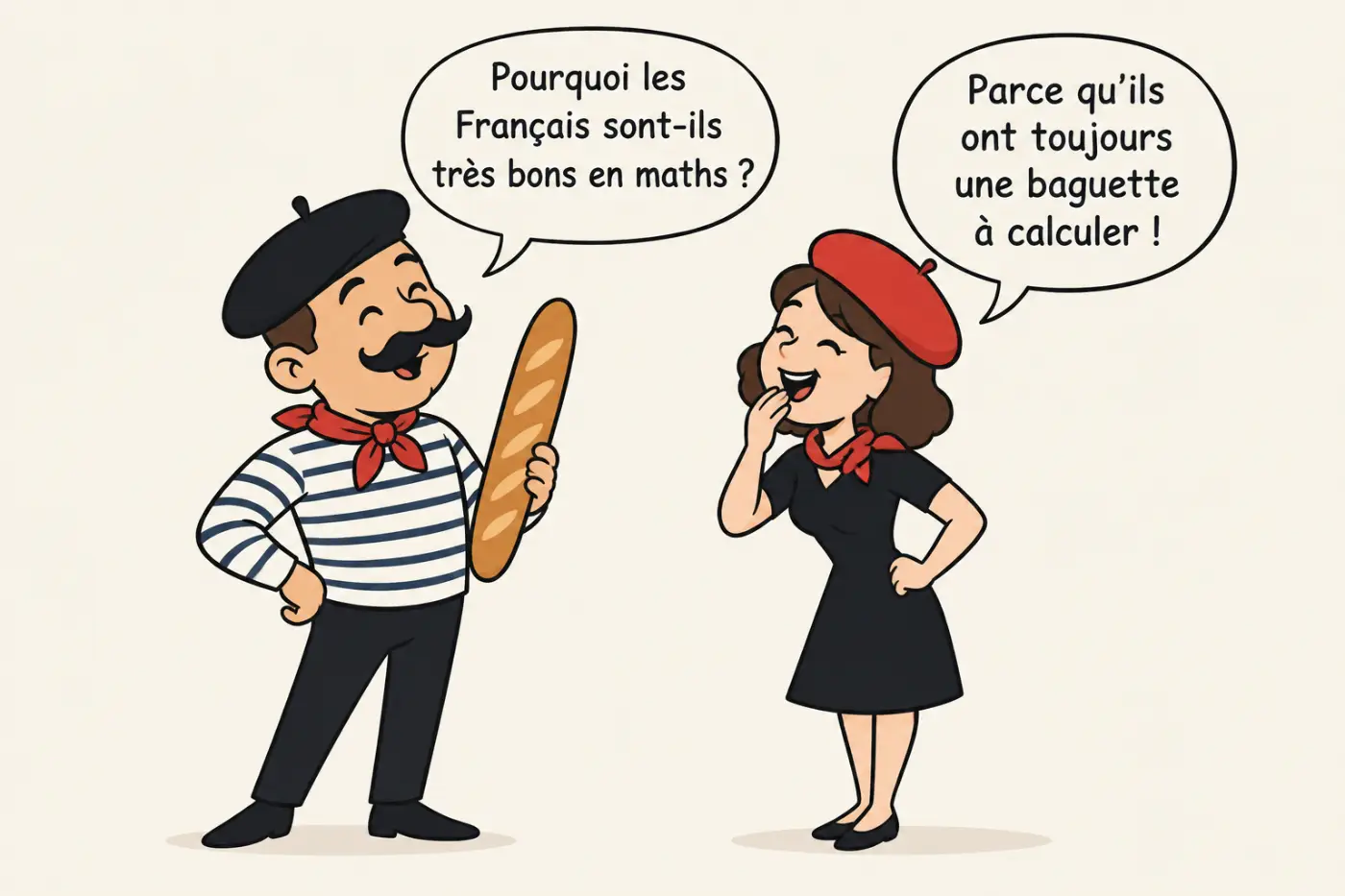
French jokes in French are a delightful way to discover the lighter side of the French language while learning expressions that make native speakers smile. From clever wordplay to silly blagues courtes, these jokes bring a little laughter to every conversation.
Whether you’re learning French, preparing for a classroom activity, planning a Paris-themed party, or simply collecting funny puns to share with friends, you’re in the right place. Each section features short jokes, with English translations where helpful, so you can enjoy the humor even if your vocabulary is still growing.
And what’s the secret to a good French joke? Sometimes it’s a clever pun, sometimes it’s a silly question, and sometimes the punchline is so bad that it’s magnifique! Get ready to say « C’est drôle ! » — that’s French for “That’s funny!”
French Jokes in French for Beginners
Learning French doesn’t have to be all grammar books and verb conjugations. These easy jokes use simple vocabulary, short questions, and playful punchlines to help beginners enjoy French humor.
1. Pourquoi les poissons n’aiment-ils pas l’école ? — Parce qu’ils ont peur du filet ! Why don’t fish like school? Because they’re afraid of the net!
2. Que dit un citron quand il braque une banque ? — Plus un zeste ! What does a lemon say when robbing a bank? Not a zest more!
3. Pourquoi les livres ont-ils toujours froid ? — Parce qu’ils ont une couverture ! Why are books always cold? Because they have a cover!
4. Que dit une tomate à une autre tomate en retard ? — Dépêche-toi, on va se faire ketchup ! What does one tomato say to another that’s late? Hurry up, or we’ll become ketchup!
5. Pourquoi les plongeurs plongent-ils toujours en arrière ? — Parce que sinon, ils tombent dans le bateau ! Why do divers always dive backward? Otherwise, they fall into the boat!
6. Quel est le comble pour un électricien ? — De ne pas être au courant ! What’s an electrician’s biggest irony? Not being informed—literally, not being “current”!
7. Pourquoi le livre de maths est-il triste ? — Parce qu’il a trop de problèmes ! Why is the math book sad? Because it has too many problems!
8. Que dit un escargot sur le dos d’une tortue ? — Youpi, ça roule ! What does a snail say riding on a turtle? Yippee, we’re rolling!
Pro Tip: Share one of these jokes a day with a learner. Ask them to guess the punchline before revealing the English translation.
Blagues Courtes: Short French Jokes
Looking for blagues courtes that are quick to read and easy to remember? These little French one-liners are perfect for text messages, social media captions, classroom warm-ups, and conversations with friends.
1. Pourquoi les oiseaux ne travaillent-ils pas ? — Ils sont toujours en congé de vol ! Why don’t birds work? They’re always on flight leave!
2. Que fait une fraise sur un cheval ? — Tagada, tagada ! What does a strawberry do on a horse? “Tagada, tagada!”—a playful sound associated with riding.
3. Pourquoi le café est-il fort ? — Parce qu’il a du caractère ! Why is coffee strong? Because it has character!
4. Comment appelle-t-on un chien magicien ? — Un labracadabrador ! What do you call a magician dog? A labracadabrador!
5. Pourquoi les escaliers sont-ils fatigués ? — Parce qu’ils montent et descendent toute la journée ! Why are stairs tired? Because they go up and down all day!
6. Que dit un ordinateur quand il a froid ? — J’ai besoin d’un petit réchauffement de données ! What does a computer say when it’s cold? I need a little data warming!
7. Pourquoi le soleil est-il si populaire ? — Parce qu’il rayonne ! Why is the sun so popular? Because it radiates!
8. Quel est le sport préféré des insectes ? — Le cricket ! What’s insects’ favorite sport? Cricket!
9. Pourquoi le fromage est-il toujours invité ? — Parce qu’il met tout le monde d’accord ! Why is cheese always invited? Because everyone agrees on it!
10. Que dit une ampoule à une autre ? — Tu m’éclaires ! What does one light bulb say to another? You brighten my day!
Pro Tip: Use these short blagues françaises as captions for memes or as a daily French-language challenge with friends.
Blagues Françaises sur la Nourriture
French food and wordplay make a delicious combination. From baguettes to cheese and croissants, these jokes turn familiar foods into punchlines that are easy to share at dinner or over a café crème.
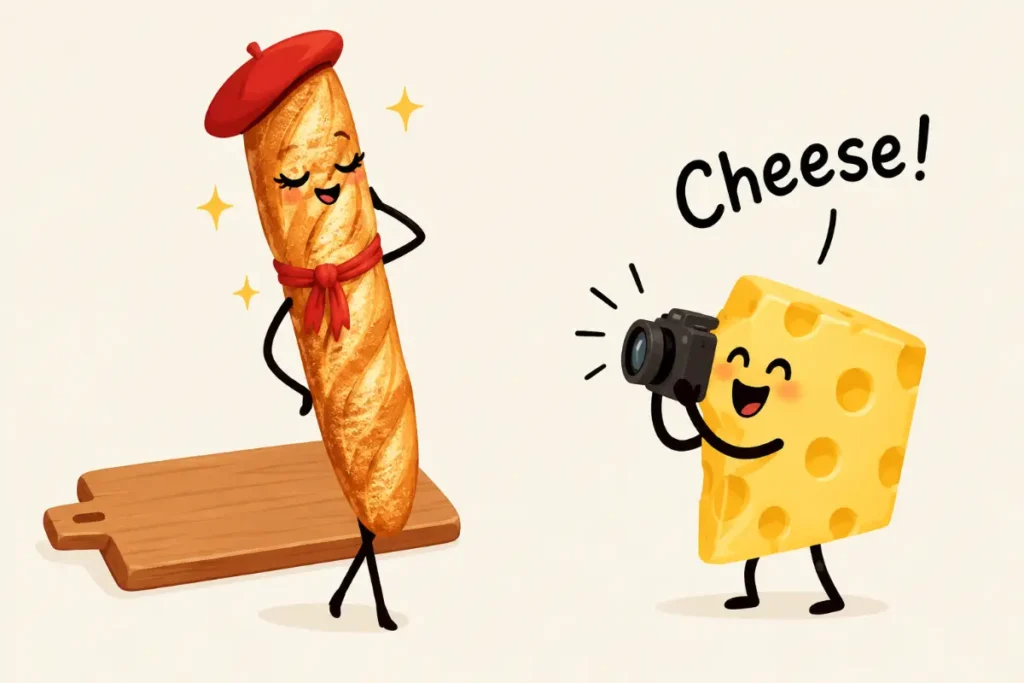
1. Pourquoi la baguette est-elle si élégante ? — Parce qu’elle a toujours du pain sur la planche ! Why is the baguette so elegant? Because it always has bread on the board!
2. Que dit le fromage quand il prend une photo ? — Cheese ! What does cheese say when it takes a photo? Cheese!
3. Pourquoi le croissant est-il mauvais en géométrie ? — Parce qu’il a toujours un angle arrondi ! Why is a croissant bad at geometry? Because it always has a rounded angle!
4. Pourquoi la soupe est-elle une bonne amie ? — Parce qu’elle réchauffe les cœurs ! Why is soup a good friend? Because it warms hearts!
5. Que dit une frite à une autre ? — On se retrouve dans le ketchup ! What does one French fry say to another? See you in the ketchup!
6. Pourquoi le gâteau est-il allé chez le médecin ? — Parce qu’il avait un coup de barre ! Why did the cake visit the doctor? Because it had a sugar slump!
7. Pourquoi les pâtes sont-elles si sociables ? — Parce qu’elles aiment se mélanger ! Why is pasta so sociable? Because it likes to mix with others!
8. Que dit un œuf à la poêle ? — Tu me chauffes ! What does an egg say to a frying pan? You’re heating me up!
Pro Tip: Print a few food puns on small cards and place them beside the dishes at a French-themed dinner party. Guests can read one before taking a bite.
Jeux de Mots Français: Clever French Wordplay
French wordplay often depends on expressions that have two meanings. These jeux de mots pair familiar phrases with unexpected twists, making them especially fun for language learners who want to expand their vocabulary.
1. Pourquoi le menuisier est-il toujours calme ? — Parce qu’il garde son sang-froid… et ses planches ! Why is the carpenter always calm? Because he keeps his cool—and his boards!
2. Pourquoi le mathématicien aime-t-il les jardins ? — Parce qu’il y trouve des racines ! Why does the mathematician love gardens? Because he finds roots there!
3. Pourquoi le boulanger est-il si riche en idées ? — Parce qu’il a du pain sur la planche ! Why is the baker full of ideas? Because he has plenty on his plate—literally, bread to prepare!
4. Pourquoi le musicien ne se perd-il jamais ? — Parce qu’il suit toujours la bonne note ! Why does the musician never get lost? Because he always follows the right note!
5. Pourquoi le jardinier ne ment-il jamais ? — Parce qu’il préfère semer la vérité ! Why does the gardener never lie? Because he prefers to sow the truth!
6. Pourquoi le coiffeur aime-t-il les bonnes histoires ? — Parce qu’il adore les récits bien coupés ! Why does the hairdresser love good stories? Because he likes well-cut tales!
7. Pourquoi l’horloger est-il ponctuel ? — Parce qu’il connaît son métier sur le bout des aiguilles ! Why is the watchmaker punctual? Because he knows his trade down to the tips of the hands!
8. Pourquoi le photographe est-il optimiste ? — Parce qu’il cherche toujours un bon angle ! Why is the photographer optimistic? Because he’s always looking for a good angle!
Pro Tip: Use these wordplay puns in French lessons. Ask learners to identify the double meaning, then invite them to invent a new pun using the same expression.
Blagues sur Paris et la Vie Française
Parisian cafés, the Eiffel Tower, the métro, and the daily search for a perfect croissant offer plenty of material for French humor. These lighthearted giggles celebrate familiar French settings without requiring advanced language skills.
1. Pourquoi la tour Eiffel ne raconte-t-elle pas de secrets ? — Parce qu’elle domine toute la conversation ! Why doesn’t the Eiffel Tower tell secrets? Because it towers over every conversation!
2. Pourquoi le métro parisien est-il un bon musicien ? — Parce qu’il connaît toutes les lignes de basse ! Why is the Paris métro a good musician? Because it knows all the bass lines!
3. Pourquoi les Parisiens aiment-ils les escargots ? — Parce qu’ils prennent leur temps, même en ville ! Why do Parisians like snails? Because they take their time, even in the city!
4. Pourquoi le café parisien est-il si bavard ? — Parce qu’il sert toujours une conversation avec l’expresso ! Why is Parisian coffee so chatty? Because it always serves conversation with espresso!
5. Pourquoi la Seine est-elle une bonne conteuse ? — Parce qu’elle a beaucoup d’histoires qui coulent de source ! Why is the Seine a good storyteller? Because its stories flow naturally!
6. Pourquoi le touriste a-t-il apporté une échelle à Paris ? — Pour prendre la tour Eiffel de plus haut ! Why did the tourist bring a ladder to Paris? To see the Eiffel Tower from even higher up!
Pro Tip: Add these Paris-themed puns to travel captions, French club newsletters, or a themed party invitation. Pair each French punchline with its English translation for a fun bilingual post.
Blagues sur les Animaux: French Animal Jokes
Animals are excellent comedy partners, especially when French expressions turn them into unexpected stars. These jokes feature cats, dogs, cows, and other creatures with a talent for delivering memorable punchlines.
1. Pourquoi les chats n’aiment-ils pas les ordinateurs ? — Parce qu’ils préfèrent les souris vivantes ! Why don’t cats like computers? Because they prefer live mice!
2. Que dit une vache quand elle entre dans un café ? — Un grand crème, s’il vous plaît ! What does a cow say when entering a café? A large cream coffee, please!
3. Pourquoi les chiens aiment-ils les arbres ? — Parce qu’ils y trouvent leurs racines ! Why do dogs like trees? Because they find their roots there!
4. Pourquoi le canard est-il un bon détective ? — Parce qu’il mène toujours l’enquête au bord de l’eau ! Why is the duck a good detective? Because it always investigates by the water!
5. Que dit un mouton devant un ordinateur ? — Je cherche le cloud ! What does a sheep say in front of a computer? I’m looking for the cloud!
6. Pourquoi le cheval est-il bon en musique ? — Parce qu’il connaît toutes les notes au galop ! Why is the horse good at music? Because it knows every note at a gallop!
7. Pourquoi les abeilles sont-elles de bonnes élèves ? — Parce qu’elles travaillent toujours en essaim ! Why are bees good students? Because they always work as a swarm!
8. Pourquoi le lion n’aime-t-il pas les examens ? — Parce qu’il préfère rugir que réviser ! Why doesn’t the lion like exams? Because it prefers roaring to revising!
Pro Tip: Turn these animal puns flashcards. Put the question on one side and the answer with its English meaning on the other.
Blagues de Papa en Français: French Dad Jokes
French dad jokes, or blagues de papa, rely on simple wordplay, predictable punchlines, and the kind of humor that makes everyone groan before laughing. Share these with your family, your French teacher, or the person who proudly tells the same joke twice.
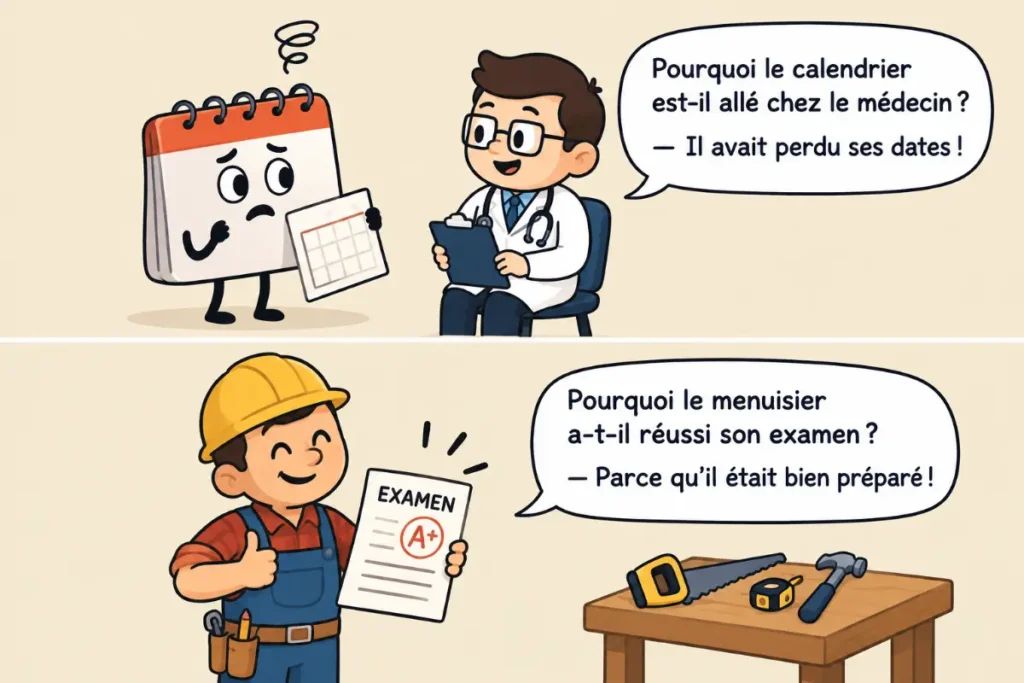
1. Pourquoi le calendrier est-il allé chez le médecin ? — Il avait perdu ses dates ! Why did the calendar visit the doctor? It had lost its dates!
2. Pourquoi le menuisier a-t-il réussi son examen ? — Parce qu’il était bien préparé ! Why did the carpenter pass his exam? Because he was well prepared!
3. Que dit un fromage à son voisin ? — Tu es vraiment affiné ! What does one cheese say to its neighbor? You’ve really matured!
4. Pourquoi le boulanger est-il toujours occupé ? — Parce qu’il a du pain sur la planche ! Why is the baker always busy? Because he has plenty on his plate!
5. Pourquoi le professeur de musique est-il ponctuel ? — Parce qu’il connaît le rythme ! Why is the music teacher punctual? Because they know the rhythm!
6. Pourquoi le livre est-il allé à la plage ? — Pour prendre un bain de soleil et tourner la page ! Why did the book go to the beach? To sunbathe and turn a page!
7. Pourquoi le jardinier a-t-il arrêté de raconter des blagues ? — Personne ne voulait les cultiver ! Why did the gardener stop telling jokes? Nobody wanted to cultivate them!
8. Pourquoi le plombier aime-t-il les réunions ? — Parce qu’il peut y faire circuler les idées ! Why does the plumber like meetings? Because ideas can flow there!
Pro Tip: Tell a French dad joke at the dinner table and pause dramatically before the punchline. The longer the pause, the more proudly the joke can be delivered.
Devinettes Drôles en Français: Funny French Riddles
Want to test your French vocabulary and your sense of humor at the same time? These funny riddles use simple questions and playful answers. Try solving each one before reading the translation.
1. Qu’est-ce qui a des dents mais ne mange jamais ? — Un peigne. What has teeth but never eats? A comb.
2. Qu’est-ce qui monte mais ne redescend jamais ? — L’âge. What goes up but never comes down? Age.
3. Qu’est-ce qui a un cou mais pas de tête ? — Une bouteille. What has a neck but no head? A bottle.
4. Qu’est-ce qui a des aiguilles mais ne coud pas ? — Une horloge. What has hands but doesn’t sew? A clock.
5. Qu’est-ce qui peut faire le tour du monde sans bouger ? — Un timbre. What can travel around the world without moving? A postage stamp.
6. Qu’est-ce qui est plein de trous mais retient l’eau ? — Une éponge. What is full of holes but holds water? A sponge.
7. Qu’est-ce qui a des feuilles mais pas de branches ? — Un livre. What has leaves but no branches? A book.
8. Qu’est-ce qui a une tête et une queue mais pas de corps ? — Une pièce de monnaie. What has a head and a tail but no body? A coin.
9. Qu’est-ce qui disparaît dès qu’on prononce son nom ? — Le silence. What disappears as soon as you say its name? Silence.
10. Qu’est-ce qui court sans avoir de jambes ? — L’eau. What runs without legs? Water.
Pro Tip: Use these riddles as a mini quiz in a French classroom or family game night. Give one point for the correct answer and a bonus point for explaining it in French.
Blagues sur l’École et les Étudiants en Français
Classroom jokes are perfect for students, teachers, and anyone who has ever stared at a difficult exam question. These school-themed puns keep the language simple while adding humor to lessons, homework, and study breaks.
1. Pourquoi le professeur porte-t-il des lunettes ? — Pour mieux voir ses élèves ! Why does the teacher wear glasses? To see the students better!
2. Pourquoi le cahier est-il toujours fatigué ? — Parce qu’il est rempli de devoirs ! Why is the notebook always tired? Because it’s full of homework!
3. Pourquoi l’élève a-t-il apporté une échelle en classe ? — Pour passer au niveau supérieur ! Why did the student bring a ladder to class? To reach the next level!
4. Pourquoi les mathématiques sont-elles difficiles ? — Parce qu’elles posent toujours des problèmes ! Why is math difficult? Because it always creates problems!
5. Pourquoi le stylo est-il allé chez le médecin ? — Parce qu’il n’avait plus d’encre dans les veines ! Why did the pen visit the doctor? Because it had no ink in its veins!
6. Pourquoi le dictionnaire est-il si intelligent ? — Parce qu’il connaît tous les mots ! Why is the dictionary so smart? Because it knows all the words!
7. Pourquoi l’élève a-t-il mangé son devoir ? — Parce que le professeur avait dit qu’il était facile à avaler ! Why did the student eat the homework? Because the teacher said it was easy to swallow!
8. Pourquoi le tableau noir est-il si calme ? — Parce qu’il a l’habitude qu’on lui écrive dessus ! Why is the blackboard so calm? Because it’s used to having things written on it!
Pro Tip: Teachers can use one joke as a warm-up before a lesson. Ask students to translate the punchline and explain which French word makes it funny.
Blagues d’Amour en Français
French is often associated with romance, so why not add a little humor to the language of love? These lighthearted jokes are ideal for couples, Valentine’s Day cards, flirty messages, and friends who appreciate a sweet pun.
1. Pourquoi es-tu comme le café ? — Parce que tu me rends accro ! Why are you like coffee? Because I’m hooked on you!
2. Tu es comme une baguette. Pourquoi ? — Parce que tu es mon pain quotidien ! You’re like a baguette. Why? Because you’re my daily bread!
3. Pourquoi mon cœur est-il un mauvais mathématicien ? — Parce qu’il ne sait compter que sur toi ! Why is my heart a bad mathematician? Because it only knows how to count on you!
4. Pourquoi les amoureux aiment-ils les calendriers ? — Parce qu’ils y trouvent toujours une date ! Why do lovers like calendars? Because they can always find a date!
5. Tu es comme le fromage. Pourquoi ? — Parce que je fonds dès que je te vois ! You’re like cheese. Why? Because I melt whenever I see you!
6. Pourquoi mon téléphone est-il jaloux ? — Parce que tu passes plus de temps dans mes pensées que sur mon écran ! Why is my phone jealous? Because you spend more time in my thoughts than on my screen!
7. Pourquoi les amoureux aiment-ils les étoiles ? — Parce qu’ils veulent toujours décrocher la lune ! Why do lovers like stars? Because they always want to reach for the moon!
8. Pourquoi es-tu comme un dictionnaire ? — Parce que tu donnes un sens à ma vie ! Why are you like a dictionary? Because you give meaning to my life!
Pro Tip: Pick a short French joke for a romantic note, then add the English translation underneath. It’s a sweet way to practice French while making someone smile.
Blagues sur le Travail et la Vie Quotidienne en Français
Work, meetings, coffee breaks, and everyday errands are universal sources of comedy. These jokes turn ordinary situations into short punchlines that work well in office chats, team newsletters, and social posts.
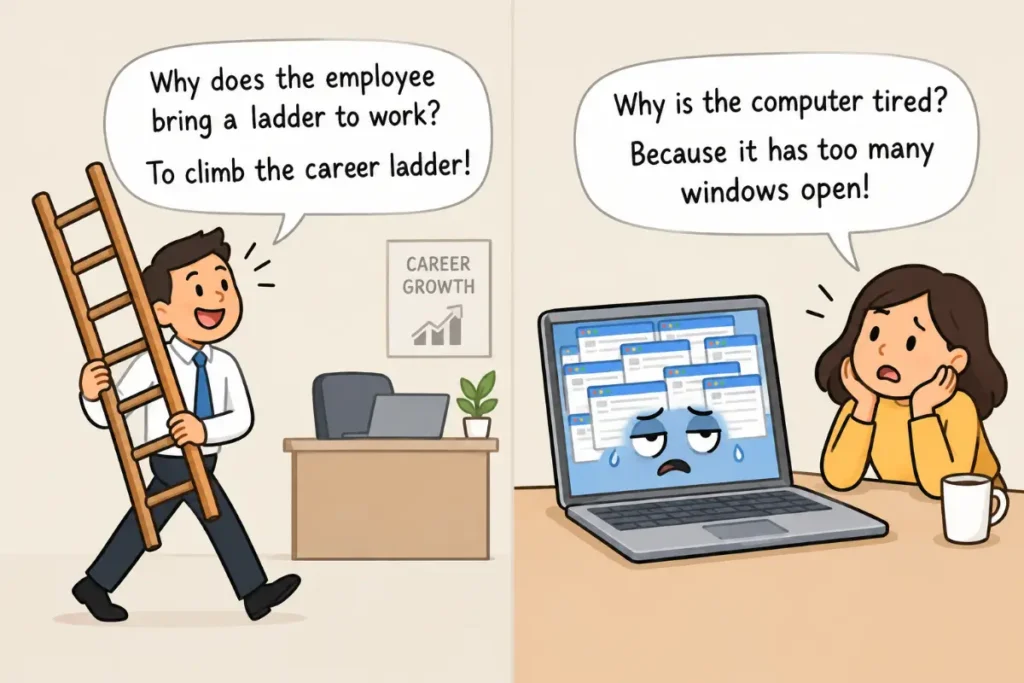
1. Pourquoi l’employé apporte-t-il une échelle au bureau ? — Pour gravir les échelons ! Why does the employee bring a ladder to work? To climb the career ladder!
2. Pourquoi l’ordinateur est-il fatigué ? — Parce qu’il a trop de fenêtres ouvertes ! Why is the computer tired? Because it has too many windows open!
3. Pourquoi le patron aime-t-il les horloges ? — Parce qu’elles font toujours avancer les choses ! Why does the boss like clocks? Because they always keep things moving!
4. Pourquoi le café est-il le meilleur collègue ? — Parce qu’il aide à tenir jusqu’à la réunion suivante ! Why is coffee the best coworker? Because it helps you make it to the next meeting!
5. Pourquoi le bureau est-il un bon endroit pour les plantes ? — Parce qu’elles y trouvent beaucoup de feuilles de calcul ! Why is an office good for plants? Because they find plenty of spreadsheets there!
6. Pourquoi le téléphone est-il un mauvais collègue ? — Parce qu’il interrompt toujours les conversations ! Why is the phone a bad coworker? Because it always interrupts conversations!
7. Pourquoi le calendrier travaille-t-il si dur ? — Parce qu’il a des journées bien remplies ! Why does the calendar work so hard? Because it has very full days!
8. Pourquoi le dossier a-t-il demandé une promotion ? — Parce qu’il contenait beaucoup d’informations ! Why did the file ask for a promotion? Because it contained lots of information!
Pro Tip: Share one workplace joke in a team chat on Friday afternoon. Keep the humor light and inclusive so everyone can enjoy the punchline.
Conclusion
French jokes in French offer more than a quick laugh. They introduce you to everyday vocabulary, familiar expressions, playful double meanings, and the charming art of delivering a punchline in another language.
From blagues courtes and dad jokes to romantic puns, school riddles, and Paris-themed humor, there’s something here for beginners, fluent speakers, teachers, and anyone who loves a good joke. Some punchlines depend on French expressions, so don’t worry if a joke takes a second read. That’s part of learning the language.
Now it’s your turn! Which joke made you laugh the most? Share your favorite in the comments, send a French pun to a friend, or challenge someone to translate a joke without looking at the English version. After all, laughter is a language everyone can share!
Frequently Asked Questions (FAQs)
What does blague mean in French?
Blague means “joke” in French. The plural is blagues. You might hear raconter une blague, meaning “to tell a joke,” or une blague drôle, meaning “a funny joke.”
Are puns difficult for beginners to understand?
Some are easy, while others depend on idioms, pronunciation, or double meanings. Start with short jokes and read the English translations. As your vocabulary grows, you’ll recognize more wordplay.
What is a popular French food joke?
One familiar example is « Que dit un citron quand il braque une banque ? Plus un zeste ! » It means, “What does a lemon say when robbing a bank? Not a zest more!” The punchline plays on the French expression un zeste, referring to a little bit of something.
How do you say “funny joke” in French?
You can say une blague drôle or une blague amusante. For “Tell me a joke,” say « Raconte-moi une blague ! »
What is a French dad joke called?
A French dad joke is commonly called une blague de papa. These jokes often feature simple puns, predictable punchlines, and playful twists on everyday expressions.
Can I use jokes to learn the language?
Absolutely! Read the joke in French, try to understand the punchline, and then check the translation. Write down unfamiliar words and practice telling the joke aloud. This approach can help reinforce vocabulary, expressions, and reading comprehension.
Where can I share giggles?
You can share them in language-learning groups, classroom activities, family chats, social media captions, or French-themed party invitations. Including an English translation makes the jokes accessible to more readers.
